<?xml version="1.0" encoding="utf-8"?><feed xmlns="http://www.w3.org/2005/Atom" ><generator uri="https://jekyllrb.com/" version="3.10.0">Jekyll</generator><link href="/feed.xml" rel="self" type="application/atom+xml" /><link href="/" rel="alternate" type="text/html" /><updated>2026-09-07T17:35:04+00:00</updated><id>/feed.xml</id><title type="html">Bridge with Chris Chung</title><subtitle>Bridge coaching, education, services, and live play.  Bridge With Chris is a service brand of Yarby LLC.</subtitle><entry><title type="html">All Western Regional with Liam and Geeske</title><link href="/session/review/2026/08/05/all-western-bracketed-swiss-with-liam-and-geeske.html" rel="alternate" type="text/html" title="All Western Regional with Liam and Geeske" /><published>2026-08-05T02:36:43+00:00</published><updated>2026-08-05T02:36:43+00:00</updated><id>/session/review/2026/08/05/all-western-bracketed-swiss-with-liam-and-geeske</id><content type="html" xml:base="/session/review/2026/08/05/all-western-bracketed-swiss-with-liam-and-geeske.html"><![CDATA[<p>Posted on my Patreon for free! I’ve posted some other goodies there for free as well.</p>

<p><a href="https://www.patreon.com/BridgeChung/posts/playing-at-all-2-168567209">Read for free on Patreon!</a></p>]]></content><author><name></name></author><category term="session" /><category term="review" /><summary type="html"><![CDATA[Posted on my Patreon for free! I’ve posted some other goodies there for free as well.]]></summary></entry><entry><title type="html">Chris’s Biggest Pet Peeve</title><link href="/misc/2026/07/05/my-biggest-pet-peeve.html" rel="alternate" type="text/html" title="Chris’s Biggest Pet Peeve" /><published>2026-07-05T02:36:43+00:00</published><updated>2026-07-05T02:36:43+00:00</updated><id>/misc/2026/07/05/my-biggest-pet-peeve</id><content type="html" xml:base="/misc/2026/07/05/my-biggest-pet-peeve.html"><![CDATA[<p><a href="https://www.patreon.com/posts/short-report-nap-152073413">Read more for free on Patreon!</a></p>

<p>Pet peeves are fun to talk about, no? I was discussing (okay, maybe baiting) a discussion about it in a chatroom by saying I was planning to write an article on peeves of pets, so naturally, people started to guess what mine was. Cha-ching! Pay dirt.</p>

<p>Well, what do you think it is? Bidding Michaels? Nah, not close. Whoa, not close? (Do you know me?) How about conventions that are easy to screw up and rarely have tangible gain? Too deep, he says. Okay, go simpler. People who abuse UI and BITs? Directors who appease the people who do such things? Top players who suggest that partner giving you UI is no problem and you should do what you felt you would always do?</p>

<p>Uh, shoot. I might have triggered myself with that last one. But no, it’s none of that. It’s not even close.</p>

<p>Enough beating around the (Mulberry) bush. My pet peeve is… people driving away people who are actually interested in the game. And the worst part is, we didn’t do it on purpose. We had nothing but the noblest of intentions.</p>

<p>Rather than clarify how we drive people away, I will share this story instead. And the people involved had no ill will.</p>

<p>A completely new player came to check out a bridge club because he knew I was getting into this great game. He picked up the biggest hand he’d ever seen in this fledgling bridge career: 20-21 balanced. He got instructed to open 2NT, so he did. His partner bid 3NT. Okay, now armed with his 20-21 high card points, he began to think if he should bid more.</p>

<p>He was quickly reprimanded and told that he has to pass, there is no other option, what are you even thinking about, you can’t bid here.</p>

<p>I could tell he was confused, and that confusion quickly turned to doubt, frustration, and possibly humiliation.</p>

<p>DO YOU KNOW HOW INCOMPREHENSIBLE THIS AUCTION, ANY AUCTION, IS TO SOMEONE WHO HAS PLAYED BRIDGE FOR TWENTY MINUTES? WHY WOULD HE KNOW ANYTHING ABOUT WHY HE CAN OR CANNOT DO SOMETHING LEGAL PER THE RULES OF BRIDGE?</p>

<p>Do you think he came back?</p>

<p>The more experienced players were just trying to share knowledge. There really was nothing malicious about it. And yet…</p>

<p>And you know why this incident sticks with me? Because I can remember with crystal clarity the times that I have done this to other people. To this day it upsets me more than you could know.</p>

<p><a href="https://arnoldkling.substack.com/p/narrower-deeper-older">Narrower, Deeper, Older.</a> Bridge is extremely involved now. Even concepts that beginning and intermediate players find absolutely simple and routine, are complete <em>voodoo</em> to people trying to break down the significant barrier of learning the game.</p>

<p>I’m older now. Hopefully I’m wiser too, but apparently there’s no guarantee that comes with age. And this is what I’ve learned after 20+ years of bridge:</p>

<p>Bridge is a <em>game</em>. It is played for <em>fun</em>.</p>

<p>I’m not a chess player, but for any chess enthusiasts out there, imagine introducing someone to chess like this:</p>

<p>“Okay that’s how all the pieces move. …No you shouldn’t make that move. Clearly you should develop all your pieces. No, don’t move that pawn. No, don’t move your Queen again. <em>guffaws</em> Oh my god you have to get your King to safety don’t move your Queen for a third time!” And for good measure, someone within earshot laughs at another move.</p>

<p>Do you think they’re going to come back?</p>

<p>When teaching people the game of bridge, simply tell them the rules. You must follow suit. Trumps beat everything else. A bid must be higher than a previous bid. <strong>Then let them play the game how they want.</strong> If they never draw trumps, <strong>who cares.</strong> If they lead all of their honors out of their hand from largest to smallest, <strong>who cares.</strong></p>

<p>Don’t laugh at new players’ blunders. Don’t tell them what they should and shouldn’t do. Let them discover the game for themselves, the thrill of trying to win the current trick they’re on. Welcome them genuinely and with open arms. When the time comes and if they are interested, they will ask for strategy.</p>

<p>Like it or not, you and I are all ambassadors of this game we love.</p>

<p>And we do love this game. Right?</p>]]></content><author><name></name></author><category term="misc" /><summary type="html"><![CDATA[Read more for free on Patreon!]]></summary></entry><entry><title type="html">Bridge Thinking Isn’t Binary</title><link href="/bidding,/mindset/2026/06/13/bridge-isnt-binary.html" rel="alternate" type="text/html" title="Bridge Thinking Isn’t Binary" /><published>2026-06-13T08:42:00+00:00</published><updated>2026-06-13T08:42:00+00:00</updated><id>/bidding,/mindset/2026/06/13/bridge-isnt-binary</id><content type="html" xml:base="/bidding,/mindset/2026/06/13/bridge-isnt-binary.html"><![CDATA[<blockquote>
  <p>It is possible to commit no mistakes and still lose. That is not a weakness. That is life.</p>
</blockquote>

<p>– Jean-Luc Picard</p>

<p><a href="https://www.patreon.com/cw/BridgeChung">Read more for free on Patreon!</a></p>

<p>This is my first “mindset” article on bridge. Everything I’ve written has been fairly technical – cardplay techniques, bidding strategy with direct tie-ins to cardplay, hand evaluation with direct tie-ins to cardplay… btw, did you know that bridge is about taking tricks?</p>

<p>So this is the first sort of mindset philosophical article that I’m writing. Some of my students know that I randomly have seemingly drug-induced rambles about bridge. This is one of them.</p>

<p>The subject I’ve chosen for this article is the fact that bridge bids are either-or. Black and white. All or nothing. Either you bid 4H, or you didn’t. Either you bid 6S, or you didn’t.</p>

<p>For newer players, they fall into the mistake of “resulting.” That’s a uniquely bridge term that poker really could adopt from us. In poker, they call it Results-Oriented Thinking (to be fair, ROT is a good acronym.) This fallacy is a classic. Because I made 12 tricks, therefore I should have bid slam. Because 3NT fails, therefore I should have stayed out. Players will commonly see that double dummy says a hand makes a certain contract, therefore it should be bid. This happened in the EZ Bridge game I volunteer and run – DD announces that 3N makes, and yet everyone who bid it went down. What did they do wrong?</p>

<p>Why, nothing of course. They finessed into a kingleton and lost the contract. Of course they should finesse. It was the best play. It just didn’t work.</p>

<p>In bridge, and perhaps in life, we must learn to separate the decision from the result. Just because a decision led to a certain result, good or bad, doesn’t mean we can judge the decision as correct or incorrect post hoc. It may be a point of datum, it may inform future decisions, but believe it or not, the two events may also be complete non sequiturs.</p>

<p>Beyond resulting, I also like to consider this principle when polling players for bidding, or judging myself on close decisions. If you give people a hand and ask them what they bid, sometimes they may spit out an answer without any reasoning or justification. Ask them: how clear is it for them? Is it automatic? Is it close? If it’s close, how close? If it was nearly as close as a coin flip, then they could have chosen the other candidate on a different day!</p>

<p>This type of thinking also occurred when I was practicing slam bidding with Borky. Naturally, in bidding lots of close slam deals, we will get them wrong. Perhaps a lot of them wrong. I don’t know if Borky despaired… but I didn’t! You know what happened? A lot of the ones we got “wrong,” we were always on the cusp. One side of the partnership showed a strong invite to slam while stopping at the game level, and the other said they had a difficult decision whether to accept.</p>

<p>To me, this is great! These razor edge decisions are inherently difficult. You take one misstep, and you get cut. But we are walking that edge, and every time it’s close, even if we end up taking a decision that doesn’t work, we actively invited/held back on the deal. The final contract is binary, the decision to bid or not is binary, but the thought process and the fact that we invited/held back regardless of the outcome is a sign that we are doing something right.</p>

<p>In conclusion, try to be objective. Recognize that the result does not 100% justify the decision. Give yourself credit for considering an action that would have worked, even if you didn’t take it. Sometimes it really is a coin flip. Don’t despair, keep honing your judgment, speak to stronger players and ask not only for their bid but also their evaluation, and you’ll discover your own strengths and weaknesses.</p>

<p>What does all of this mean? I don’t know. My students are probably laughing at me now. I don’t do drugs, I swear.</p>]]></content><author><name></name></author><category term="bidding," /><category term="mindset" /><summary type="html"><![CDATA[It is possible to commit no mistakes and still lose. That is not a weakness. That is life.]]></summary></entry><entry><title type="html">Putting it Into Practice: No Fit does not mean No Trumps</title><link href="/bidding/2026/05/17/piip-play-trumps-with-no-fit.html" rel="alternate" type="text/html" title="Putting it Into Practice: No Fit does not mean No Trumps" /><published>2026-05-17T07:15:00+00:00</published><updated>2026-05-17T07:15:00+00:00</updated><id>/bidding/2026/05/17/piip-play-trumps-with-no-fit</id><content type="html" xml:base="/bidding/2026/05/17/piip-play-trumps-with-no-fit.html"><![CDATA[<p>This entire post is free on my Patreon! I didn’t want to have to format it for images, so click through!</p>

<p><a href="https://www.patreon.com/posts/158638722">Full article</a></p>]]></content><author><name></name></author><category term="bidding" /><summary type="html"><![CDATA[This entire post is free on my Patreon! I didn’t want to have to format it for images, so click through!]]></summary></entry><entry><title type="html">Defensive Blunders: Don’t Ruff a Grape!</title><link href="/defensive/techniques/2026/05/03/defensive-blunders-dont-ruff-a-grape.html" rel="alternate" type="text/html" title="Defensive Blunders: Don’t Ruff a Grape!" /><published>2026-05-03T02:36:43+00:00</published><updated>2026-05-03T02:36:43+00:00</updated><id>/defensive/techniques/2026/05/03/defensive-blunders-dont-ruff-a-grape</id><content type="html" xml:base="/defensive/techniques/2026/05/03/defensive-blunders-dont-ruff-a-grape.html"><![CDATA[<p><a href="https://www.patreon.com/cw/BridgeChung">Read more for free on Patreon!</a></p>

<blockquote>
  <p>What do you think declarer is going to discard, a grape!?</p>
</blockquote>

<ul>
  <li>Eddie Kantar</li>
</ul>

<p>You can blame my bridge hero for this name. This blunder is simply a violation of ABC (Always Be Counting), but giving it a name makes it humorous and may help you remember to count in the first place. Do it, you won’t.</p>

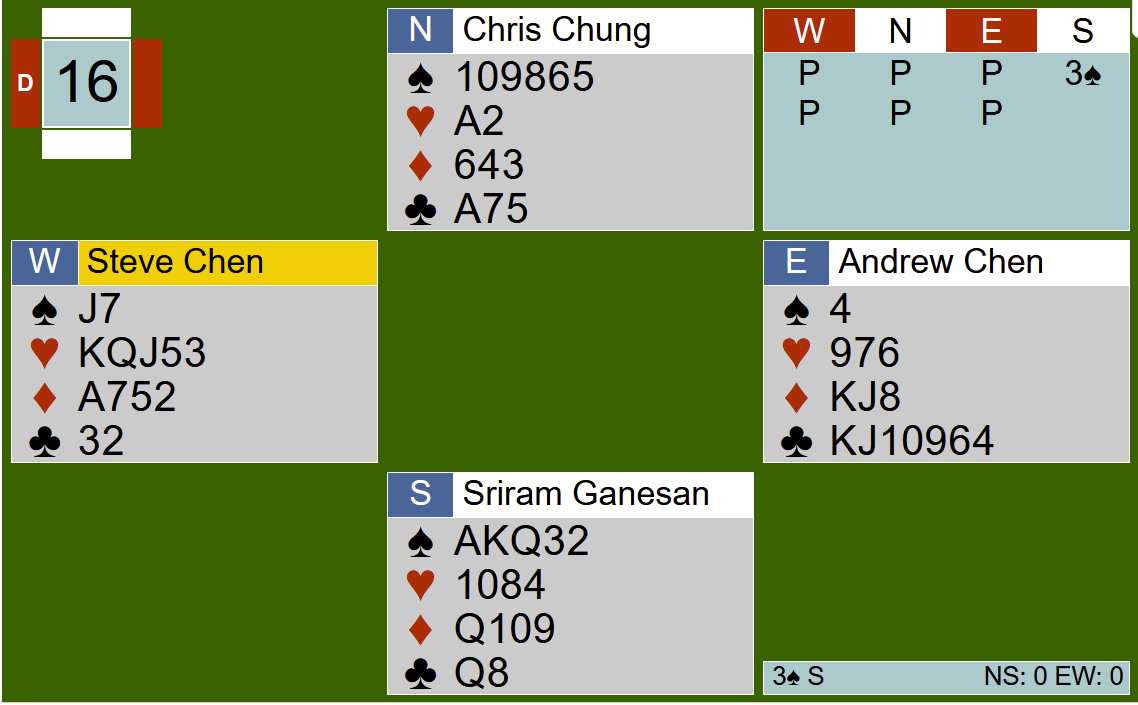
<p>This is a hand from a sectional. I was dummy.</p>

<p><img src="/images/dont-ruff-grape.png" alt="don't ruff a grape" /></p>

<p>There’s another declarer technique on display here. I call it Side Winner Pronto, or Side Winner Stat! Let me know which you prefer, or if you think they’re both lousy.</p>

<p>Declarer won the singleton heart lead in hand and played a diamond immediately (good!) The defense did some not so great things, and we reach this position pictured below. Note that from East’s point of view, declarer is known to have 2 diamonds, 2 hearts, and has shown up with 3 spades. Partner (West) has ruffed twice with the C9 and the CK.</p>

<p><img src="/images/dont-ruff-grape2.png" alt="don't ruff a grape 2" /></p>

<p>So declarer is winning the trick in dummy. Should East overruff? I would tell you not to peek at South’s hand, but if you stop to take stock of what’s happened, you know that declarer is down to only clubs! They already showed up with 7 cards outside of clubs and had preempted 3C – would you agree that the rest of declarer’s hand is trumps? :)</p>

<p>DO NOT RUFF! You only weaken your trump holding! You are long trump hand for the defense now. If you ruff, declarer overruffs, ducks a club, and next your Jack falls under the Queen. This is how the play went at the table.</p>

<p>What did you think declarer is going to discard on this trick, a grape?</p>

<p>Don’t ruff a grape!</p>]]></content><author><name></name></author><category term="defensive" /><category term="techniques" /><summary type="html"><![CDATA[Read more for free on Patreon!]]></summary></entry><entry><title type="html">Bridge Jargon Glossary</title><link href="/misc/2026/04/26/bridge-jargon-glossary.html" rel="alternate" type="text/html" title="Bridge Jargon Glossary" /><published>2026-04-26T07:15:00+00:00</published><updated>2026-04-26T07:15:00+00:00</updated><id>/misc/2026/04/26/bridge-jargon-glossary</id><content type="html" xml:base="/misc/2026/04/26/bridge-jargon-glossary.html"><![CDATA[<blockquote>
  <p>I call this phenomenon <strong>Narrower, Deeper, Older.</strong> For a hobby that has been around a generation or two, fewer people find the hobby accessible. The people involved in the hobby are deeply involved. They have attained a high skill level. There is no supplier that caters to a casual participant. And the average age of participants is much older than it used to be.</p>
</blockquote>

<p>– Arnold Kling, <a href="https://arnoldkling.substack.com/p/narrower-deeper-older">Narrower, Older, Deeper</a></p>

<blockquote>
  <p>We have jump bids and skip bids but no hop bids. And we can run (from a double) and walk (the dog) and leap(ing Michaels) and crawl(ing Stayman)</p>
</blockquote>

<p>– Coach Cyrus</p>

<p>There are so many terms that bridge players use as common parlance that are completely inscrutable, even perhaps to other bridge players! So in the spirit of pulling back the curtain, I’ve decided to make my own glossary.</p>

<p>Also, those who know me know that I have a penchant for silliness and gibberish. I will note when some jargon is particularly silly.</p>

<h2 id="on-the-subject-of-hand-and-suit-distributions">On the subject of hand and suit distributions</h2>
<h3 id="shape">Shape</h3>

<p>Four numbers that add to 13. 4432, 5332, 5431, et al. This is the “shape” of a hand, or of a suit.</p>
<blockquote>
  <p>Declarer preempted 3C with 1345 shape! Can you believe it?!</p>
</blockquote>

<blockquote>
  <p>Diamonds were 4333 around the table.</p>
</blockquote>

<h3 id="fit">Fit</h3>
<p>Two numbers that describe declarer’s and dummy’s trump length.</p>
<blockquote>
  <p>I played the 4-4 diamond fit instead of the 5-4 heart fit.</p>
</blockquote>

<h3 id="break">Break</h3>

<p>How the remaining cards in a suit split in the opponents’ hands</p>
<blockquote>
  <p>The diamonds broke 3-2 so I had plenty of tricks.</p>
</blockquote>

<h3 id="bad-breakbroke-bad">Bad break/broke bad</h3>

<p>An unlucky/very uneven split.</p>
<blockquote>
  <p>Trumps broke bad. 4-1 offside.</p>
</blockquote>

<h2 id="on-the-subject-of-describingnarrating-hands">On the subject of describing/narrating hands</h2>
<h3 id="singleton">Singleton</h3>

<p>One card in a suit.</p>

<h3 id="stiff">Stiff</h3>

<p>Synonym of singleton.</p>

<h3 id="kingleton-silly">Kingleton (silly!)</h3>

<p>Singleton king. I’m sure this has been invented independently many times over.</p>

<h3 id="queengleton-extra-silly">Queengleton (extra silly!)</h3>

<p>Eh. I think I’ve heard it before in jest.</p>

<h3 id="jingleton-extra-silly">Jingleton (extra silly!!!)</h3>
<p>Okay nobody says this. We always say stiff Jack.</p>

<h3 id="tight">Tight</h3>

<p>2-3 honors alone with no supporting cards.</p>
<blockquote>
  <p>My hearts? KQ tight.</p>
</blockquote>

<h3 id="long-legged">Long Legged</h3>

<p>5-5 or more extreme shape.</p>

<h3 id="swan">Swan</h3>

<p>7-4 shape.</p>

<h3 id="albatross">Albatross</h3>

<p>8-4 shape.</p>

<h3 id="quack">Quack</h3>
<p>A queen or a jack.</p>

<h3 id="bullet">Bullet</h3>
<p>An Ace.</p>

<h3 id="nth-n-to-the-card-n-dead-n-bagger">Nth, N to the card, N dead, N bagger</h3>
<p>All of these are ways to narrate suit lengths.</p>

<p>3 dead, 4 bagger, 5 to the Q, Q fifth.</p>

<p>The implication is that the spot cards are small/irrelevant.</p>

<blockquote>
  <p>I held Queen Jack sixth.</p>
</blockquote>

<blockquote>
  <p>I had a 5 bagger.</p>
</blockquote>

<blockquote>
  <p>I held 5 to the Queen.</p>
</blockquote>

<h3 id="empty-nth">Empty Nth</h3>
<p>Like Nth, but emphasizing the uselessness of the spots.</p>

<blockquote>
  <p>Declarer had Ace empty fourth.</p>
</blockquote>

<h3 id="n-times">N times</h3>
<p>Like Nth. I haven’t heard this used in a long time though.</p>

<blockquote>
  <p>He held the K five times.</p>
</blockquote>

<h3 id="and-1-dub">and 1, dub</h3>
<p>When a basketball shooter is fouled on the play but makes the shot, and gets to take 1 extra free throw.</p>

<p>No, it’s a way of describing a doubleton. King and one, Jack and one, etc.</p>

<p>Or King dub, Queen dub.</p>

<h3 id="moose-rock-crusher">Moose, rock crusher</h3>
<p>A very, very good hand. Usually tons of high card points, but also tricks.</p>

<h3 id="texture-purity">Texture, Purity</h3>
<p>Whether the hand has honors and good spot cards in its long suits or its short suits</p>

<p>K xxxxx xxxxx AK has very poor texture or purity.</p>

<p>x AKxxx KT9xx xx has very good texture or purity.</p>

<h3 id="odr">ODR</h3>
<p>Stands for Offense to Defense Ratio. Very closely related to texture and purity, but also takes into consideration being balanced vs having more shape.</p>

<h3 id="aces-and-spaces">Aces and spaces</h3>
<p>A weird way of poo-pooing a hand that has Aces and spot cards. Oh boo hoo, I was dealt Aces.</p>
<h2 id="on-the-subject-of-cardplay">On the subject of cardplay</h2>
<h3 id="finesse">Finesse</h3>

<p>Trying to win with a card that is not absolutely high. The most classic example is leading low toward AQ and playing the Q.</p>

<h3 id="hook">Hook</h3>

<p>Synonym of finesse. Can be used interchangeably.</p>
<blockquote>
  <p>I took the spade hook.</p>
</blockquote>

<blockquote>
  <p>I hooked the spade.</p>
</blockquote>

<blockquote>
  <p>I took the spade finesse.</p>
</blockquote>

<h3 id="onside">Onside</h3>

<p>If a finesse works, that card was <em>onside.</em> It was placed the <em>side</em> we wished it was <em>on</em>.</p>

<h3 id="in-the-pocket-slotted">In the Pocket, Slotted</h3>

<p>See onside.</p>

<h3 id="offside">Offside</h3>

<p>Antonym of onside.</p>

<h3 id="chinese-finesse">Chinese Finesse</h3>
<p>Leading an honor as an illegitimate finesse. For example, leading Q from Qxx toward Axx.</p>

<p>I’m Chinese, you can say it. I give you permission.</p>

<h3 id="practice-finesse">Practice Finesse</h3>
<p>Taking a finesse that cannot gain a trick and can only cost a trick. Your finesse was for <em>practice.</em></p>

<h3 id="plain-suit">Plain suit</h3>

<p>A suit that is not trumps.</p>

<h3 id="ruff">Ruff</h3>
<p>A verb synonym of trump.</p>

<blockquote>
  <p>You can give your partner a ruff, but you can’t give your partner a trump.</p>
</blockquote>

<p>– Ted Hwa</p>

<h3 id="pitch-toss-shake-shed-throw-etc">Pitch, Toss, Shake, Shed, Throw, etc.</h3>
<p>Failing to follow suit and playing a plain suit.</p>

<h3 id="sluff">Sluff</h3>
<p>Same as pitch. Rarely used unless it’s in conjunction with ruff, e.g. ruff and sluff.</p>

<h3 id="carved-butchered-chopped-it-up">Carved, Butchered, Chopped it up</h3>
<p>When declarer takes a really, really bad line and went down.</p>

<h2 id="on-the-subject-of-second-hand-play">On the subject of second hand play</h2>
<h3 id="split">Split</h3>
<p>To play a high card from touching cards in second seat.</p>
<blockquote>
  <p>He split the J from JT9.</p>
</blockquote>

<h3 id="duck">Duck</h3>
<p>To play a small card when you could have played a high one.</p>
<blockquote>
  <p>You have to duck the Ace twice.</p>
</blockquote>

<h3 id="cover">Cover</h3>
<p>Playing an honor over an opponent’s played honor.</p>
<blockquote>
  <p>Cover an honor with an honor!</p>
</blockquote>

<h3 id="fly-hop-left-jab-sky-rise">Fly, Hop, Left Jab, Sky, Rise</h3>
<p>Playing second hand high.</p>

<h3 id="drop">Drop</h3>
<p>When a significant card falls underneath another.</p>
<blockquote>
  <p>He dropped my Kingleton offside!</p>
</blockquote>

<h3 id="pin">Pin</h3>
<p>When first seat plays a highish card and drops a significant card from 4th seat.</p>

<div class="language-plaintext highlighter-rouge"><div class="highlight"><pre class="highlight"><code>   AQ876
K32 --- T
   J954
</code></pre></div></div>

<p>If south leads the J, the T will get <strong>pinned</strong>.</p>

<h3 id="crash">Crash</h3>
<p>When one sides honors are spent on the same trick. May or may not be forced.</p>

<blockquote>
  <p>Partner flew the King and crashed my Queen!</p>
</blockquote>

<h3 id="idiot-coup">Idiot Coup</h3>
<p>Trying to get your opponents to crash their top honors. Usually Kx – A</p>

<h3 id="grosvenor">Grosvenor</h3>
<p>A play that loses, but does not actually lose because your opponents give it back to you because they cannot fathom that you have made such a huge blunder.</p>

<p>Guys you have to read the article. It’s my favorite piece of bridge literature ever.</p>

<p><a href="https://www.bridgebum.com/grosvenor.php">Grosvenor Gambit</a></p>

<h3 id="greek-gift">Greek Gift</h3>
<p>Giving declarer something that he cannot do himself (like a finesse) in an attempt to harm him should he accept it. For example, if the honor is offside and he cannot finesse and will be forced to drop it, so you give him the finesse.</p>

<h3 id="nullo">Nullo</h3>
<p>A line of play that is strictly dominated by another. (This is a bad thing.)</p>

<h3 id="miami-endplay">Miami Endplay</h3>
<p>In a 3 card ending, instead of endplaying your opponent, you endplay yourself!</p>

<div class="language-plaintext highlighter-rouge"><div class="highlight"><pre class="highlight"><code>  --- Q92
  AJ8
</code></pre></div></div>

<p>You can exit the 8 and achieve an endplay. Or you can cash the A and achieve a Miami Endplay.</p>

<h2 id="on-the-subject-of-bidding-and-conventions">On the subject of bidding and conventions</h2>
<h3 id="strain">Strain</h3>
<p>An all inclusive word for trumps that includes NT. The strains are clubs, diamonds, hearts, spades, NT.</p>

<h3 id="bid">Bid</h3>
<p>A bid! A bid is a number followed by a strain.</p>

<h3 id="call">Call</h3>
<p>An all inclusive word for any bid you can make at the bridge table. This includes pass, double, redouble.</p>

<h3 id="punt-wiggle">Punt, Wiggle</h3>
<p>A call that shows nothing. Used to buy time/try to get partner to bid something.</p>

<h3 id="grunt">Grunt</h3>
<p>A nebulous minimum opening bid. Something like 1D showing 2+ diamonds and 11-15 points.</p>

<h3 id="drop-bail">Drop, Bail</h3>
<p>To end the auction in some contract.</p>

<blockquote>
  <p>Partner opened 1NT and I dropped him in 2S</p>
</blockquote>

<blockquote>
  <p>They tried to double us in 2H but partner bailed to 3C!</p>
</blockquote>

<h3 id="psych">Psych</h3>
<p>Often spelled “psyche” by bridge players. Maybe we’re all fortune tellers or something.</p>

<p>A bid that is a deliberate and gross distortion of your hand. The intent (deliberate) is significant.</p>

<p>It’s short for “psychic,” which also makes no sense. Yes I know the origin and it still makes no sense don’t @ me I will not be taking further questions.</p>

<h3 id="swish">Swish</h3>
<p>When a bid gets passed out.</p>

<blockquote>
  <p>What was the auction?
4S swish.</p>
</blockquote>

<h3 id="check">Check</h3>
<p>Pass. Poker players, am I right?</p>

<h3 id="hit-it-blood-business-whack-wield-the-axe-drop-the-hammer">Hit it, blood, business, whack, wield the axe, drop the hammer</h3>
<p>Doubling for penalty.</p>

<h3 id="convert-sit">Convert, sit</h3>
<p>When partner makes a takeout double, but you <strong>convert</strong> it to penalty by passing.</p>

<h3 id="hit-it-back-send-it-back">Hit it back, send it back</h3>
<p>Redoubling for penalty.</p>

<h3 id="heat-seeking-train-the-guns">Heat seeking, train the guns</h3>
<p>A double that announces values and intent to penalize.</p>

<h3 id="chicken-texas-sillyish-but-also-accurate">Chicken Texas (sillyish but also accurate)</h3>

<p>Texas Transfers are a commonly played convention where 4D shows hearts and 4H shows spades. Sometimes, if we’re worried that partner may not understand that 4H shows spades, we might bid 4S ourselves. So 4D shows hearts, 4H shows spades but we’re chicken, so we bid 4S.</p>

<h2 id="on-the-subject-of-bridge-scores">On the subject of bridge scores</h2>
<h3 id="kiss-of-death">Kiss of Death</h3>
<p>A bridge score of 200. At matchpoints, +200 is often a top/-200 is a bottom.</p>

<h3 id="sticks-and-wheels">Sticks and Wheels</h3>
<p>A score of 1100. Two sticks, two wheels.</p>

<h3 id="going-for-a-number-a-telephone-number">Going for a number, a telephone number</h3>
<p>A large penalty. I suspect the etymology is because 800 is a telephone number.<br />
Edit: piggrass informs me that telephone numbers used to be four digits!</p>

<h3 id="top">Top</h3>
<p>A very good matchpoint score. Taken literally, it means 100%, but often is used as hyperbole/approximation. To emphasize a full 100%, people often use an adjective along with top. A cold top, a complete top, tippy top, etc.</p>

<h3 id="push">Push</h3>
<p>At imps, a board with no swing (no imps gained or lost.)</p>

<h2 id="on-the-subject-of-written-notation">On the subject of written notation</h2>
<h3 id="suit-order">Suit Order</h3>
<p>When suits are not notated (and they should not be; it makes it harder to read), the implicit order is SHDC.</p>

<h3 id="parentheses">Parentheses</h3>
<p>Parentheses are used to describe shape that is interchangeable within the parens. (31)(54) means 31 in the majors either way around, 54 in the minors either way around.</p>

<h3 id="dash-vs-equal">Dash vs Equal</h3>
<p>5-4-3-1 is synonymous with 5431: any 5431 shape.<br />
5=4=3=1 is exactly 5 spades, 4 hearts, 3 diamonds, 1 club.</p>

<h2 id="on-the-subject-of-total-nonsense">On the subject of Total Nonsense</h2>
<h3 id="sdam">SDAM</h3>
<p>A weird joke about how Six Diamonds Always Makes.</p>

<h3 id="both-sides-favorable">Both Sides Favorable</h3>
<p>Chew on that one for a while.</p>

<h3 id="british-terms-to-describe-the-four-vulnerability-combinations">British terms to describe the four vulnerability combinations</h3>
<p>Oh bugger off, ya wanker.</p>

<h3 id="the-beer-card">The Beer Card</h3>
<p>The D7 is known as the beer card. Roughly speaking (people play by different rules, but these should be universal), if you make your contract as declarer and the D7 was your final winning trick, partner owes you a beer. Diamonds may not be trumps.</p>

<p>Same for the defense if they set the contract.</p>

<p>The most important asset in Bridge Brawl.</p>

<h3 id="chicken-blackwood">Chicken Blackwood</h3>
<p>When you discover you’re missing once Ace/keycard, so you sign off in 5.</p>

<h3 id="australian-push">Australian Push</h3>
<p>A difference of 7 or fewer imps. Maybe the number is different (higher?), but you get the idea.</p>

<h3 id="the-rule-of-n">The rule of N</h3>
<p>Hey, I have a bridge to sell you!</p>

<h3 id="standard-no-agreement">“Standard”, “No Agreement”</h3>
<p>Alright, keep your secrets.</p>

<h3 id="dsip">DSIP</h3>
<p>Do Something Intelligent, Partner. See Blame Transfer below.</p>

<h3 id="blame-transfer">Blame Transfer</h3>
<p>Setting up your partner to make the final mistake.</p>

<h3 id="cuebid">Cuebid</h3>
<p>AN OVERLOADED TERM WHY DO WE CALL CONTROL BIDS CUEBIDS AS WELL</p>

<h3 id="table-feel">Table Feel</h3>
<p>Taking an anti-percentage play because you’re psychic. See? That’s how you use the word “psychic.”</p>

<h3 id="sos">SOS</h3>
<p>How to get into even more trouble than you’re already in.</p>

<h3 id="ubh">UBH</h3>
<p>use brain H</p>

<h3 id="well-it-had-play">Well, it had play</h3>
<p>You went down. Contract was terrible.</p>

<h3 id="cold">Cold</h3>
<p>Describing to your partner how obvious it was to make it.</p>

<h3 id="frigid">Frigid</h3>
<p>Really, REALLY obvious.</p>

<h3 id="lurker-check">Lurker Check</h3>
<p>How to save face when you draw an extra round of trump after everyone’s out.</p>

<blockquote>
  <p>Lurker Check, haha!</p>
</blockquote>

<h3 id="expert-standard">Expert Standard</h3>
<p>How to justify all of your (incorrect) bidding.</p>

<h3 id="you-want-me-to-poll-this-on-bridgewinners-ill-poll-this-on-bridgewinners">You want me to poll this on BridgeWinners!? I’ll poll this on BridgeWinners!!</h3>
<p>Yeah, that’ll go well.</p>]]></content><author><name></name></author><category term="misc" /><summary type="html"><![CDATA[I call this phenomenon Narrower, Deeper, Older. For a hobby that has been around a generation or two, fewer people find the hobby accessible. The people involved in the hobby are deeply involved. They have attained a high skill level. There is no supplier that caters to a casual participant. And the average age of participants is much older than it used to be.]]></summary></entry><entry><title type="html">Dispelling Beginner Myths: No Fit = No Trumps!</title><link href="/bidding/2026/04/14/dispelling-myths-play-NT-if-no-fit.html" rel="alternate" type="text/html" title="Dispelling Beginner Myths: No Fit = No Trumps!" /><published>2026-04-14T07:15:00+00:00</published><updated>2026-04-14T07:15:00+00:00</updated><id>/bidding/2026/04/14/dispelling-myths-play-NT-if-no-fit</id><content type="html" xml:base="/bidding/2026/04/14/dispelling-myths-play-NT-if-no-fit.html"><![CDATA[<p><a href="https://www.patreon.com/cw/BridgeChung">Read more for free on Patreon!</a></p>

<p>A solid partner preempts 2S and we have x AQJ AKxxx AJxx. 19 points, nice! But partner preempted us, grr.<sup id="fnref:1" role="doc-noteref"><a href="#fn:1" class="footnote" rel="footnote">1</a></sup> There’s no spade fit, trying 5m would be really far away, so we try 3NT, right?</p>

<p>Would you believe it, down 2 or 3. Unlucky! Partner had a good suit: KQJTxx. What happened? Is 25 HCP not enough for 3N?</p>

<p><img src="/images/nfnt1.png" alt="no-fit-no-trump-1" /></p>

<p>Let’s take a look at another deal.</p>

<p>We have Kx Q9x Q9xxx AJT. We deal and the auction goes:</p>

<p>1D 1S<br />
1N 2H</p>

<p>So partner has a hand like 5 spades and 4 hearts. You might hope partner has 5 hearts and pass. I would bid 2S and try to play the 5-2 or the 6-2.</p>

<p>The one bid you should <em>not</em> make? 2N.</p>

<p>This is the full deal:</p>

<p><img src="/images/nfnt2.png" alt="no-fit-no-trump-2" /></p>

<p>In 2NT on the natural club lead, the opponents are entitled to 3 clubs, 2 diamonds, 1 red trick, and 1 spade. That’s 7 tricks for the defense! This is not <em>anywhere</em> close to making. (I could have been a <em>lot</em> meaner! Move a diamond honor to E and give somebody 5 clubs…)</p>

<p>What about 2S? I see 3 spade tricks, 2 heart tricks, a club is 6. The 13th heart promotes a trump trick for us for 7. If spades behaved, we would gain a natural spade trick. (It’s irrelevant if spades/hearts behave in NT. Crazy, huh?) Making/down 1 versus down 2 is a big deal! Also, opponents in the know will know how bad 2NT is, and are more likely to double you. Especially on this auction.</p>

<p>So what lesson can we take away from all of this?</p>

<blockquote>
  <p>No fit does not mean no trumps!</p>
</blockquote>

<p><strong>NT is a very difficult strain!</strong><sup id="fnref:2" role="doc-noteref"><a href="#fn:2" class="footnote" rel="footnote">2</a></sup> There’s a reason it’s ranked the highest; it’s the hardest to take a lot of tricks in!</p>

<p>Roughly speaking, there are two kinds of good NT contracts.</p>
<ol>
  <li>We have a (super)majority of the high card points, both hands are balanced-ish, and have no good fit. Think a 1NT or 3/4NT contract.</li>
  <li>We have what I call a rip and run hand – cash a solid long suit, bang out aces, and go home.</li>
</ol>

<p>This topic is very complex, so I want to leave you with a few guidelines in common auctions to avoid playing NT, even if you don’t fit. <em>Particularly</em> when you don’t fit.</p>

<h2 id="guideline-1">Guideline 1</h2>
<blockquote>
  <p>Choose a 5-2 fit over an underpowered NT.</p>
</blockquote>

<p>I had a Fourth Suit Forcing 1 round auction a few weeks ago, and we stopped in 2M on a 5-2 fit. I gleefully announced that I could play 2M instead of 2N, then recoiled in horror when trumps broke 5-1. And then I made it. They couldn’t stop me. 2NT had <em>no</em> play. It was that dire!</p>

<h2 id="guideline-2">Guideline 2</h2>
<blockquote>
  <p>If partner preempts and you don’t fit, play partner’s suit!</p>
</blockquote>

<p>Take a look at the very first hand of the article. Did you notice anything? <strong>4S is a much better contract,</strong> especially on a non-club lead. We are lucky that partner’s suit is so good, but it doesn’t take luck to see that partner’s spades will be useless to us in 3N unless he has an entry to cash the suit after we set it up. But in spades, his spades will always be useful.</p>

<h2 id="guideline-3">Guideline 3</h2>
<blockquote>
  <p>Choosing NT after partner preempts is a rip and run!</p>
</blockquote>

<p>For partner’s preemptive hand to have any value in 3NT, either we expect to run his suit, or we expect to run our own secret suit! This is a rip and run!</p>

<p>I wrote an <a href="https://www.patreon.com/posts/evaluating-153703258">article on my Patreon</a> about hand evaluation, and how true hand evaluation comes from not counting length or shortness or fractional points, but from experience in trick taking and cardplay. Years of getting burnt playing underpowered or inappropriate NTs led to these well-known guidelines.</p>

<h2 id="bonus-hand">Bonus Hand</h2>
<p>Captain, take a look at this. How would you rate NT vs spades?
<img src="/images/nfnt3.png" alt="nfnt3" /></p>

<hr />

<p>PS.</p>

<p>On the first hand, it is difficult to figure out what the best contract is with the South hand during the bidding. If partner shows bad suit good hand, then we may try 3NT. If partner shows a good suit, we need to be in spades. Regardless, the main thrust is that we cannot simply choose NT because we don’t fit.</p>

<hr />

<h3 id="footnotes">Footnotes</h3>

<div class="footnotes" role="doc-endnotes">
  <ol>
    <li id="fn:1" role="doc-endnote">
      <p>Partner described his hand. <a href="#fnref:1" class="reversefootnote" role="doc-backlink">&#8617;</a></p>
    </li>
    <li id="fn:2" role="doc-endnote">
      <p>Strain just means clubs, diamonds, hearts, spades, or NT as a contract. It’s an all-inclusive word for trumps that also includes NT. <a href="#fnref:2" class="reversefootnote" role="doc-backlink">&#8617;</a></p>
    </li>
  </ol>
</div>]]></content><author><name></name></author><category term="bidding" /><summary type="html"><![CDATA[Read more for free on Patreon!]]></summary></entry><entry><title type="html">My team won the first ever Bridge Brawl!</title><link href="/news/2026/04/11/our-team-won-bridge-brawl.html" rel="alternate" type="text/html" title="My team won the first ever Bridge Brawl!" /><published>2026-04-11T07:15:00+00:00</published><updated>2026-04-11T07:15:00+00:00</updated><id>/news/2026/04/11/our-team-won-bridge-brawl</id><content type="html" xml:base="/news/2026/04/11/our-team-won-bridge-brawl.html"><![CDATA[<p>My team and I won Kai’s Bridge Brawl!! This has to be my best win in bridge to date, and I’m so happy. Really, my teammates were fantastic and they carried me over the finish line.</p>

<p>Side note: if you see anyone complaining that this format is “not bridge,” well they can go kick rocks. David Burn even points out that it strictly <em>is</em> bridge, as the scoring can be determined by the regulating authority, which is Kai. And basically he’s introduced even <em>more</em> decisions than we would usually have to think about during a bridge deal.</p>

<p>Here are a few videos of some matches from my POV.</p>

<p><a href="https://www.youtube.com/watch?v=hZNxwUI5oNw">Semifinal Recap vs BridgewithSteve</a></p>

<p><a href="https://www.youtube.com/watch?v=YsfHIJx7ALI">Quarterfinal Recap vs John Stell</a></p>

<p>Here’s the VOD/Vugraph with live commentary vs Pete Hollands in the grand finals:
<a href="https://www.youtube.com/watch?v=R3E10-DDI5k">Bridge Brawl Championship Grand Final</a></p>]]></content><author><name></name></author><category term="news" /><summary type="html"><![CDATA[My team and I won Kai’s Bridge Brawl!! This has to be my best win in bridge to date, and I’m so happy. Really, my teammates were fantastic and they carried me over the finish line.]]></summary></entry><entry><title type="html">Bridge Fundamentals: Third Hand High (Enough)</title><link href="/play/2026/04/07/bridge-fundamentals-third-hand-high-enough.html" rel="alternate" type="text/html" title="Bridge Fundamentals: Third Hand High (Enough)" /><published>2026-04-07T07:15:00+00:00</published><updated>2026-04-07T07:15:00+00:00</updated><id>/play/2026/04/07/bridge-fundamentals-third-hand-high-enough</id><content type="html" xml:base="/play/2026/04/07/bridge-fundamentals-third-hand-high-enough.html"><![CDATA[<p><em>More experienced players will know about gapped finessing vs dummy (okay I made up that term right now but I bet you can figure out what it means.) This article will not cover gap finesses, because that is seriously so, so hard.</em></p>

<p>Many partnership things in bridge are something you and partner discuss and decide beforehand. Conversations like</p>
<blockquote>
  <p>If I open 1S, I show 5+ spades and 12+ points.</p>
</blockquote>

<blockquote>
  <p>If I play a small card, that’s encouraging.</p>

  <p>“What about when declarer leads the suit?”</p>

  <p>Oh, then my small card shows an odd number.</p>
</blockquote>

<p>But Third Hand High (Enough) is one of the few things in bridge that is <strong>not</strong> a partnership agreement. It is simply the <strong>only correct way</strong> to play. This article talks about what to play from <strong>equivalent</strong> cards in third seat when attempting to win the trick.</p>

<h1 id="but-why-third-hand-high">But why Third Hand High?</h1>

<p><img src="/images/zoolander-male-models.jpg" alt="zoolander" /></p>

<p><em>In all of the diagrams, declarer is south, the closed hand. We are either E or W.</em></p>

<p>Let’s start at the beginning. What is third hand high? Why is third hand high? And would anyone please ask, <em>how</em> is third hand high?</p>

<p>Third Hand High applies when you are in third seat and you are trying to <strong>win</strong> the trick.</p>

<div class="language-plaintext highlighter-rouge"><div class="highlight"><pre class="highlight"><code>     AK2
5   -----   Q863
    (closed
      hand)
</code></pre></div></div>
<p>Declarer calls one of the top honors from dummy. This is not third hand high. We can give a signal here. Spoilers: we are not winning this trick.</p>

<p>Let’s take a look at when third hand high applies.</p>

<div class="language-plaintext highlighter-rouge"><div class="highlight"><pre class="highlight"><code>    654
2  -----  QT3
  (closed
    hand)
</code></pre></div></div>
<p>Partner leads the 2 and dummy plays the 4. What card do we play? The 3, letting declarer win a cheap trick? No way.</p>

<p>So is the T good enough? Imagine declarer has AJ5. If we play the T, declarer will win the J. Then later he will take the A, for a total of two tricks. This is the layout.</p>

<div class="language-plaintext highlighter-rouge"><div class="highlight"><pre class="highlight"><code>      654
K972 -----  QT3
      AJ8 
</code></pre></div></div>
<p>Declarer is not entitled to the J! I urge you to lay out the cards yourself and try this to be sure you understand it. If we put in the Q, declarer can win the A or not. Regardless, East will play the T next, and declarer’s J will be trapped and cannot score a trick.</p>

<p>So when we play third hand high, we play our <em>highest</em> card, not our high-ish card.<sup id="fnref:1" role="doc-noteref"><a href="#fn:1" class="footnote" rel="footnote">1</a></sup></p>

<p>Let’s try another fundamental one.</p>

<div class="language-plaintext highlighter-rouge"><div class="highlight"><pre class="highlight"><code>    876
 2 ----- K95
  (closed
    hand)
</code></pre></div></div>

<p>Are you worried that your King will be captured by the Ace? That’s okay! Do not let declarer win a cheap trick! If you don’t drive out the Ace now, they’ll simply win some spot (like the T or the J), and still have the Ace for later! If this is the full layout:</p>

<div class="language-plaintext highlighter-rouge"><div class="highlight"><pre class="highlight"><code>      876
QT42 -----  K95
      AJ3 
</code></pre></div></div>

<p>Then declarer is entitled to the A and A alone. The J cannot be scored legitimately, <em>unless</em> you do not put up the K. By playing third hand high, we are trying to punch declarer’s high card in the mouth.</p>

<p>This is the goal of third hand high. Note that it’s not <em>always</em> right to play third hand high – you still have to use logic and be thinking. But if your third hand high prevents declarer from winning a cheap trick while also potentially establishing partner’s (or your own) high cards, then it’s probably right.</p>

<h1 id="but-why-third-hand-high-enough">But why Third Hand High (Enough)?</h1>

<p><img src="/images/zoolander-male-models-again.jpg" alt="zoolander" /></p>

<p>Third Hand High (Enough) is how a defending partnership can begin to sort out their combined holdings. Let’s look at an example from above, but improve one single card.</p>

<div class="language-plaintext highlighter-rouge"><div class="highlight"><pre class="highlight"><code>     654
 2  -----   QJ3
  (closed
    hand)

</code></pre></div></div>
<p>Partner leads the 2.</p>

<p>Our suit in the previous section was QT3. We had to follow the Q, third hand high, to prevent declarer from winning the J.</p>

<p>This time we have QJ3. So we could follow either of the high cards. They’re equivalent; who cares which one we play? We just gotta play one, right?</p>

<p>Right?</p>

<p>Unfortunately, partner cannot see our cards! If we play the Q, partner won’t know that we have the J. Okay, so we play the J, <em>lowest of equivalents.</em> That shows the Q, right?</p>

<p>Well… it’s a little more complicated than that. What if we were dealt the J and no higher honor? Then we would have to play J, third hand high, right? So what gives? What the hell is the point of this article?</p>

<p>When third hand plays 3HH, the strictly correct interpretation is that third hand’s card <em>denies</em> the card below. So when we follow the Q, it denies the J. When we follow the J, it denies the T. It does <strong>not</strong> promise the Q. It may <em>imply</em> it.</p>

<p>What if we had QJT instead of QJ3? Then we play the T. QJT95? Play the 9.</p>

<p>Often, it will still be ambiguous. But at least there is the chance that partner has the next higher cards. In fact, sometimes it will be very clear!</p>

<div class="language-plaintext highlighter-rouge"><div class="highlight"><pre class="highlight"><code>     AJ2
876 ----- Q played
   (closed
    hand)
</code></pre></div></div>

<p>Let’s say we chose to lead the 8 of this suit, top of nothing vs the opponents’ NT. Declarer calls small from dummy. Partner plays the Q and it wins the trick.</p>

<p>Where is the K?</p>

<p>Partner has it, right!? What declarer would duck the Q here? So in this case, partner’s Q while not promising the K, makes it quite clear who holds it! It would behoove us to continue this suit at our first opportunity. Partner cannot attack it from his side; only we can play this suit.</p>

<p>For completeness, let’s try the same thing as E. It is important when reading and practicing to do it from both sides of the partnership! It will help you build empathy, a critical bridge skill. And life skill. Maybe.</p>

<div class="language-plaintext highlighter-rouge"><div class="highlight"><pre class="highlight"><code>      AJ2
  8  -----  KQ54
    (closed
      hand)
</code></pre></div></div>
<p>Partner leads the 8. Declarer follows small from dummy. You play the Q. Good job!</p>

<p>Notice how cruel this is on partner if you follow the K. Why on earth would partner think that you have the Q? In fact, when we understand 3HHE, the play of the K <strong>denies</strong> the Q.</p>

<p>Now let me change this hand just a little more.</p>

<div class="language-plaintext highlighter-rouge"><div class="highlight"><pre class="highlight"><code>    AJ2
 6 ----- KQT93
  (closed
    hand)
</code></pre></div></div>

<p>Wow, hell of a lead, partner! When dummy plays small, we contribute the <em>nine</em>, <strong>lowest</strong> of equivalents. Dummy’s J is finessed, so our T9 are equivalents to the KQ too. When it holds the trick, partner will know what’s up. Also, when we win the trick, we will continue with the K, <strong>top of an honor sequence.</strong></p>

<p>In summary, Third Hand High (Enough) is only when following in third seat, and only when we are trying to actively contribute to the trick. Follow lowest of equivalents to give your side a chance to analyze the deal correctly and put up your best fighting chance! And once you understand this rule, you can understand when you should violate it, and the fact that partner will see your violation and will be wondering why you have done this may alert him that something drastic needs to happen on the deal!</p>

<p><a href="https://www.patreon.com/cw/BridgeChung">Read more for free on Patreon!</a></p>

<div class="footnotes" role="doc-endnotes">
  <ol>
    <li id="fn:1" role="doc-endnote">
      <p>As usual, there are exceptions. Against a trump contract, we can play the J from KJ, a discovery play. This is free, <strong>if</strong> partner has not underled their A. <a href="#fnref:1" class="reversefootnote" role="doc-backlink">&#8617;</a></p>
    </li>
  </ol>
</div>]]></content><author><name></name></author><category term="play" /><summary type="html"><![CDATA[More experienced players will know about gapped finessing vs dummy (okay I made up that term right now but I bet you can figure out what it means.) This article will not cover gap finesses, because that is seriously so, so hard.]]></summary></entry><entry><title type="html">Declarer Cardplay Technique: There and Back Again</title><link href="/play/2026/03/25/declarer-technique-there-and-back-again.html" rel="alternate" type="text/html" title="Declarer Cardplay Technique: There and Back Again" /><published>2026-03-25T07:15:00+00:00</published><updated>2026-03-25T07:15:00+00:00</updated><id>/play/2026/03/25/declarer-technique-there-and-back-again</id><content type="html" xml:base="/play/2026/03/25/declarer-technique-there-and-back-again.html"><![CDATA[<p>This is one of my favorite declarer play techniques, and I don’t know if anyone’s named it<sup id="fnref:1" role="doc-noteref"><a href="#fn:1" class="footnote" rel="footnote">1</a></sup>. It’s certainly well known, but if you haven’t seen it before, it’s hard to spot! I call it There and Back Again. Any Tolkien fans out there?</p>

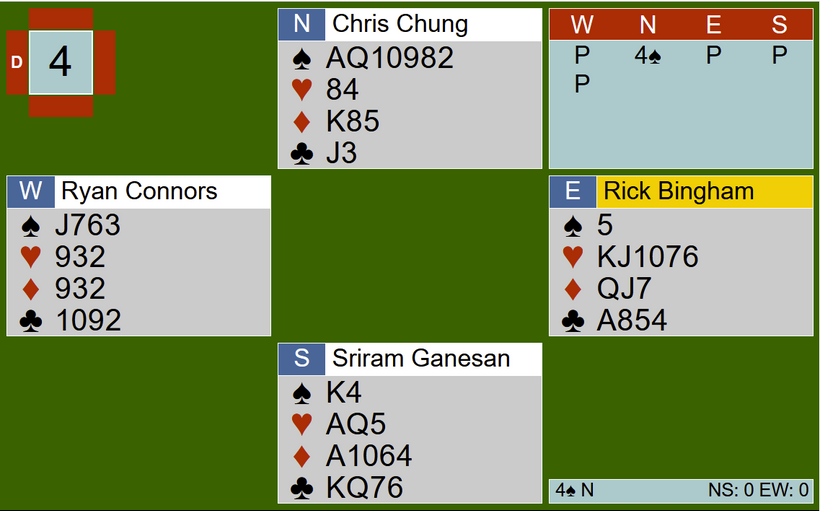
<p>You land in 4S. Plan the play. Avid bridge readers will know that South is usually the declarer. Well, It’s north here. Deal with it.</p>

<p>Also, this was a real deal in the Bridge Brawl. I’m south, and I held a true yarborough. Wowza!</p>

<p><img src="/images/declarer-play-there-and-back-again.png" alt="taba1" /></p>

<p>I like to count <strong>winners</strong> at every contract. Ideally though, you should count both winners and losers.</p>

<p>On this deal, you have 3 red losers. The goal is to take 10 black winners. Clearly, we will need spades 3-2, else we have an unavoidable trump loser. What about clubs?</p>

<p><img src="/images/declarer-play-there-and-back-again-2.png" alt="taba2" /></p>
<p style="text-align: center;"><em>When both suits break 3-2, you can play all the top trumps and then all the top clubs.</em></p>

<p>If clubs are 3-2, you will have 10 tricks naturally. What if clubs are 4-1 though? If you didn’t consider this, I urge you to pause here and try planning the hand once more.</p>

<p><img src="/images/confused-math-lady.webp" alt="confused math lady" /></p>

<p>Are you still stuck? Let me try giving you a suggestion. Let’s say EW take their 3 red tricks (doesn’t matter). Now come two rounds of trumps. Both follow. Now try two rounds of clubs…</p>

<ol>
  <li>What if both players follow to 2 rounds of clubs?</li>
  <li>What if one defender ruffs the second club?</li>
  <li>What if one defender shows out but does <em>not</em> ruff the second club?
<img src="/images/prof-x-thinking.png" alt="professor x" /></li>
</ol>

<blockquote>
  <p>1 - What if both players follow to 2 rounds of clubs?</p>
</blockquote>

<p>In scenario 1, you drew two rounds of trump (finding them 3-2) and played two rounds of clubs (also finding them 3-2). Hooray! Everything broke! Now go back and finish drawing trumps, then finish playing clubs. This is why I call this technique <strong>There and Back Again.</strong> We played two rounds of trumps, then went over <strong>there</strong> (clubs) to test the suit. When the suit breaks, we go <strong>back again</strong> to finish drawing trumps. We take 5 spades and 5 clubs.</p>

<p>Now let’s see what happens if one defender ruffs the second round of clubs when clubs were 4-1.</p>

<blockquote>
  <p>2 - What if one defender ruffs the second club?</p>
</blockquote>

<p><img src="/images/declarer-play-there-and-back-again-3.png" alt="taba3" /></p>
<p style="text-align: center;"><em>Bad news! East has ruffed the 2nd club. We are down 1. But wait...</em></p>

<p>Are you thinking, “So what? We’re down already.” Yes, we lost 3 red tricks and a defensive ruff. But how exactly were you going to deal with your 4th round club loser? Remember, they broke badly in order for a defender to be able to ruff the second round. It doesn’t matter if you draw a 3rd trump before playing clubs. You will just lose the 4th round of clubs instead. This is 9 tricks (5 spades, 4 clubs.)</p>

<p>But look at this! When they ruff the 2nd club, you don’t actually lose a trick! In return, <em>you</em> will ruff the 4th round of clubs. This establishes your clubs for 9 total tricks - 5 spades, 1 club ruff, 3 clubs. You break even. You can lose a ruff or you can lose a club.</p>

<p>And now, finally, scenario 3…</p>

<p><img src="/images/declarer-play-there-and-back-again-4.png" alt="taba4" /></p>

<blockquote>
  <p>3 - What if one defender shows out but does <em>not</em> ruff the second club?</p>
</blockquote>

<p>Then <em>we</em> get to ruff the clubs good! In the diagram above, you play a 4th round of clubs as West follows suit. Now you play a red suit to get to your hand, draw the final trump, and cash the 5th club. You score 5 spades, 1 ruff, 4 clubs.</p>

<p>If you total up the three scenarios…</p>

<ol>
  <li>When both suits broke 3-2, you went <strong>There and Back Again.</strong> This line breaks even with the “naive” line of playing all the spades and all the clubs.</li>
  <li>When clubs broke badly, you still broke even for -1. You traded a defensive ruff for an offensive ruff.</li>
  <li>When clubs broke badly BUT the defender with short clubs did not have more than 2 trumps, we make the contract when the “naive” line fails.</li>
</ol>

<p>So <strong>There and Back Again</strong> breaks even with the naive line in most cases, and is pure upside in one specific case!</p>

<p>This is a recurring theme about managing trumps in trump contracts. Often, the defender that scores a ruff is the long hand in trumps, and the trick may come back.</p>

<p>I showed this hand to a student, and he berated himself for not seeing obvious things like this. This is the only time I will tell someone they are straight up <strong>wrong</strong>. This is <strong>not</strong> obvious! Bridge is a very hard game, and things only eventually become obvious (at least, I hope so. I’m still waiting for that moment) when we learn it and experience it a lot.</p>

<p><a href="https://www.patreon.com/cw/BridgeChung">Read more for free on Patreon!</a></p>

<div class="footnotes" role="doc-endnotes">
  <ol>
    <li id="fn:1" role="doc-endnote">
      <p>I’ve been informed by Gonzalo that this is called the Guillemard maneuver. Sorry Guillemard, I like my name better. On with the article! <a href="#fnref:1" class="reversefootnote" role="doc-backlink">&#8617;</a></p>
    </li>
  </ol>
</div>]]></content><author><name></name></author><category term="play" /><summary type="html"><![CDATA[This is one of my favorite declarer play techniques, and I don’t know if anyone’s named it1. It’s certainly well known, but if you haven’t seen it before, it’s hard to spot! I call it There and Back Again. Any Tolkien fans out there? I’ve been informed by Gonzalo that this is called the Guillemard maneuver. Sorry Guillemard, I like my name better. On with the article! &#8617;]]></summary></entry></feed>