Dispelling Myths: Bidding 4M with 5 card support
Read more for free on Patreon!
This is something that I once learned, and still see many people do. I believe I read it in a Goren book.
Your partner opens 1M. You have 5 card support. You must now bid game! Either it will make, or it will be a good save.
That is the myth.
Bidding game on any hand with 5 card support is definitely not some blanket heuristic that you can apply and win boards. It’s difficult to quantify when you should or shouldn’t bid game, but there is at least one scenario that I can think of where you should almost never do this: when your hand is 5M332.
I think there is this blaze of glory that people often look for when they play bridge. They want to nobly sacrifice when the opponents are bidding game, make some heroic read that opps are making it and that our dive will be cheaper than the value of their game. Or perhaps that our call will shut them out of the auction completely, let us play 4M when they were on for 5 or 6 of something and they get it wrong. Or, perhaps people vastly overestimate the value of their trumps. In either case, I think the mundanity of it all is: balanced hands are not that exciting. Just bid the value of your hand.
And the value of that 5th trump when you are 5332? Bad.
What is the point of having extra trumps if you can’t ruff anything? The whole joy of having a trump suit is being able to win tricks with your special asset, knowing that you can render your opponents’ HCP ineffective. What will you ruff when your side suits are 3-3-2? They play 3 rounds of the 3 card suit. Either partner follows, or maybe partner ruffs the 3rd round. Then they play the other 3 card suit, and your side follows to all of those. And then finally the doubleton, which you know partner is definitely gonna follow to two rounds. If your hand was bad, do you really think you were a favorite to make 10 tricks? What good did the 5th trump do? Did you ruff in your doubleton suit? If so, wouldn’t just tabling 4 card support have done the trick?
And now, on the sacrificial side – if you have so much as a scattered 6 point hand, your side has at least 18 HCP. If second seat interferes, I may decide to make a tactical 4M call (it’s complicated…) but I just want to impress on you that this doomsday/glory scenario does not happen that much. You know what does happen a lot? We start with a simple value raise, be it 2M, 3M, or even a goofy 1N. Let’s examine what happens after that.
1S P 2S P
P ?
Imagine that LHO somehow passes. This isn’t just hypothetical; it has really happened to me before with 10 trumps. It goes to the balancing seat, and what do opps do when they balance? They try to push us up one level. The whole philosophy of balancing is to fight once for a fit, push the opponents up a level, and then sell out. I’m not saying they’ll never bid game, but it is exceedingly unlikely. Nobody wants to “hang” (common bridge parlance) their partner for trying to get their opponents out of 2M.
What if 4th seat interferes?
1S P 2S X
P ?
In this day and age, most consider this a pre-balance. It is, in essence, a balancing call. So all of the same philosophies apply. Whatever RHO bids, we can always compete to 3S over it. And now partner will have a little more info from the auction when he declares.
And believe it or not, you play 2M sometimes! I have been allowed to play it in the following ways:
1N P 2H P
2S P P P
1S P 2S P
P P
In the NT auction, I had opened 1NT with 5M332, nearly fell out of my chair when partner transfered to spades, and bid a boring 2S (hand wasn’t good enough for a superaccept.) I fully expected to be pushed to 3 and was ready to bid it, of course, but they let me play it. And I took exactly 8 tricks.
Even if you get pushed as in the above scenarios, you are only playing 3, not 4. At matchpoints? Yes please. At imps? Vully undertricks still hurt! And even if it’s nv, I would still like to win 2 imps. And all this precludes you getting doubled – even when their double is takeout, they are not bound to do so! Especially not when it forces them to the 5 level…
Here’s a hand from NAP A where we scored an 85%.
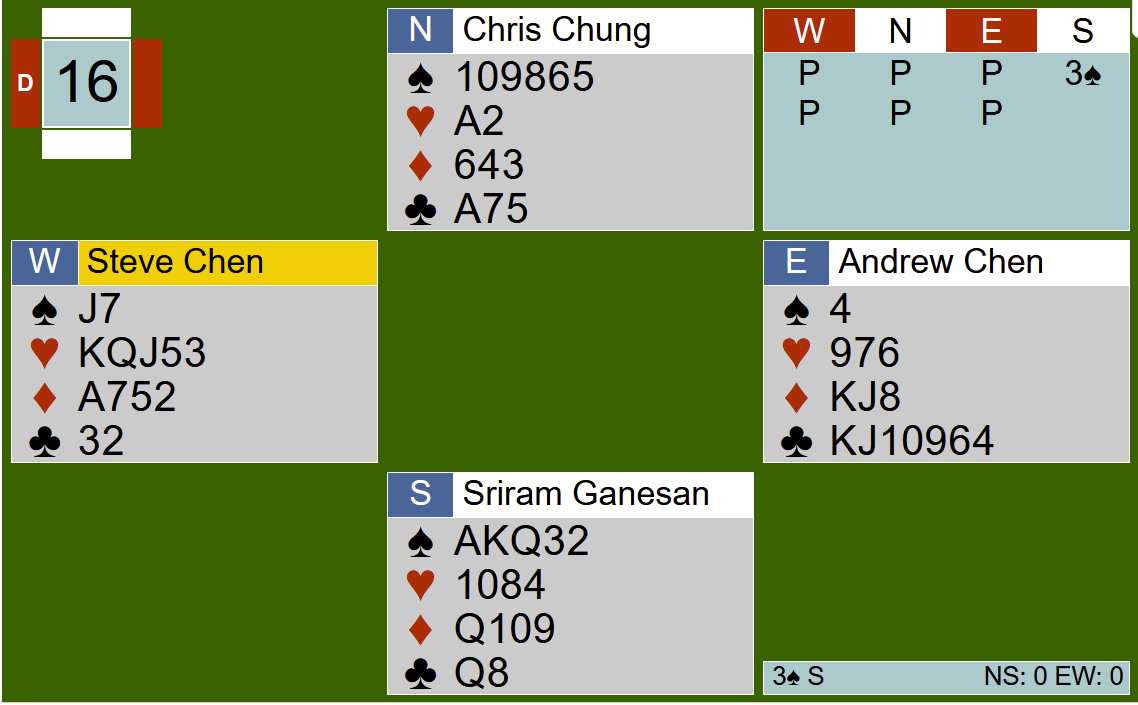
The auction went
1H P 2D* 2S
P 3S P P
P
Believe it or not, I felt a little guilty even raising to 3! You can see that we are off a heart, a club, and potentially 3 diamonds. The hand makes because the DJ is onside. And what exactly was my 5th trump good for?
In short, with 5M332 when partner opens your major, make your normal value raise. Do you play 1M 3M limit raise, and you have that range? Bid that. Do you have a mixed raise? Make that raise. Are you 6-10, or perhaps 8-10 if you play constructive raises? Do that. When you are flat, you can ignore the 5th trump. It’s nice, but for now, pretend it isn’t there.
This article focused on 5M332 shape, because it is uniquely bad in my experience. Other shapes are complicated, and I don’t have a magic bullet for you. 5224, 5431? I’m really not sure. Bridge is hard.
There are more applications of this besides 5M332, and it’s always the same story. 4M333 and 3M433 are even more obviously bad than 5M332. If your hand is flat, what are you ruffing? That is the whole purpose of a trump suit, after all. The one thing that extra trumps may do for you is reduce the number of trump losers, like if partner’s missing the Q or something. But if you don’t score ruffs… now we’re slugging it out with pure HCP. I don’t like fair fights in bridge, and I don’t think you should either. Not if you’re playing a high level contract.
Jazi Zilber insightfully comments:
Two more points.
- Daniel Kleineman says “balanced hands defend”. Which is a nice general heuristic. With a balanced hand you mainly have you high cards, and those work as good in defence.
- Spades are unique in that running to 4s is many times not needed. 1s - 3s. And opponents are many times already out of the bidding